
DJI Neo 2 Motion Fly More Combo

DJI Neo 2 Motion Fly More Combo
Key Features
- DJI Neo 2 Motion Fly More Combo weighs 151g for lightweight, portable flight
- Omnidirectional obstacle sensing improves environmental awareness [2]
- Gesture control enables hands-free operation in suitable conditions [3]
- ActiveTrack supports faster subject tracking up to 12 m/s [4]
- Records 4K video at up to 60fps with slow-motion support [7]
- 49GB internal storage reduces reliance on external memory
- Motion controller enables responsive flight using hand movement [12]
- DJI Goggles provide live FPV viewing for immersive control [8]
- Fly More accessories extend total flight time across multiple batteries
DJI Neo 2 Motion Fly More Combo Summary
The DJI Neo 2 Motion Fly More Combo combines the Neo 2 drone with FPV goggles, a motion controller and additional batteries, introducing an immersive control method alongside automated flight modes. It remains a lightweight 151g follow-me camera drone with subject tracking and 4K video, while expanding how the aircraft can be flown.
This version includes DJI Goggles N3 and a compatible motion controller, allowing real-time FPV viewing and directional control through hand movement [8][12]. Standard app-based control, gesture input and automated capture modes remain available, providing flexibility between hands-free and manual operation.
The 4K drone introduces omnidirectional obstacle sensing [2] and forward-facing LiDAR for improved navigation, with performance dependent on environmental conditions. A 12MP 1/2-inch CMOS sensor records 4K video at up to 60fps, with 100fps slow-motion available in supported modes [7][15]. The 2-axis gimbal maintains smoother footage during movement.
ActiveTrack supports faster subject tracking [4], while Gesture Control [3], SelfieShot and Return to Palm allow automated capture when not using FPV control. Internal storage remains at 49GB, reducing reliance on external memory for shorter sessions.
Additional batteries and the charging hub extend total flight time across multiple flights, while Wi-Fi transmission supports operation up to 500m in low-interference environments [18]. The DJI Neo 2 Motion Fly More Combo adds a more direct and immersive control option while retaining simplified capture modes. It tracks subjects automatically for travel, social media clips and everyday content without requiring manual control.
DJI Neo 2 Motion Fly More Combo in More Detail
Master Flight With Ease
Neo 2 includes an onboard display, take-off button and mode switch for direct control without a remote. The aircraft launches from your palm and enters automated flight modes immediately [5]. Return to Palm locates your hand and completes controlled landings in suitable conditions [3].
More Control options
The drone supports multiple control methods depending on how you want to operate it. It can fly fully hands-free using tracking and automated modes, or be controlled via the DJI Fly app with virtual joysticks [10]. Optional RC-N3 or RC 2 controllers provide traditional stick input, while compatible goggles and motion controller enable FPV flight [8][12].
Gesture Control [3]
Gesture control allows directional input using hand movements within a short operating range [3]. The system adjusts position and framing without requiring a controller, when used in open, well-lit environments.
Voice Control via Mobile
Voice commands are supported via a connected mobile device [9][10]. When paired with Bluetooth earphones [11], the system allows basic flight control without physical input. Audio can also be recorded through the connected device, with propeller noise reduced during processing.
Tracking system
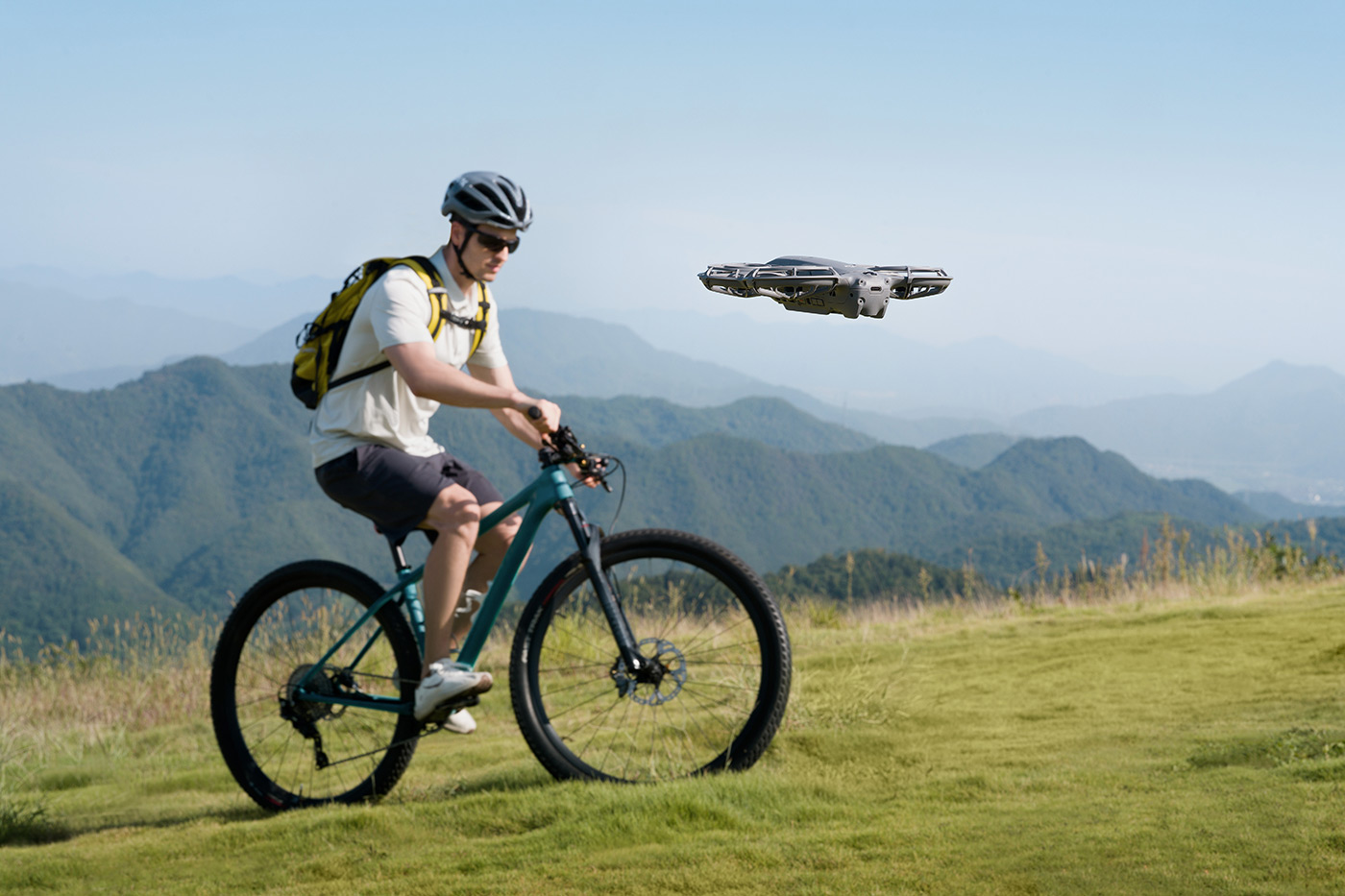
ActiveTrack maintains subject framing during movement and supports tracking speeds up to 12 m/s in suitable conditions [4][14]. The system includes a Cycling mode for faster subjects and maintains positioning during directional changes.
Obstacle sensing
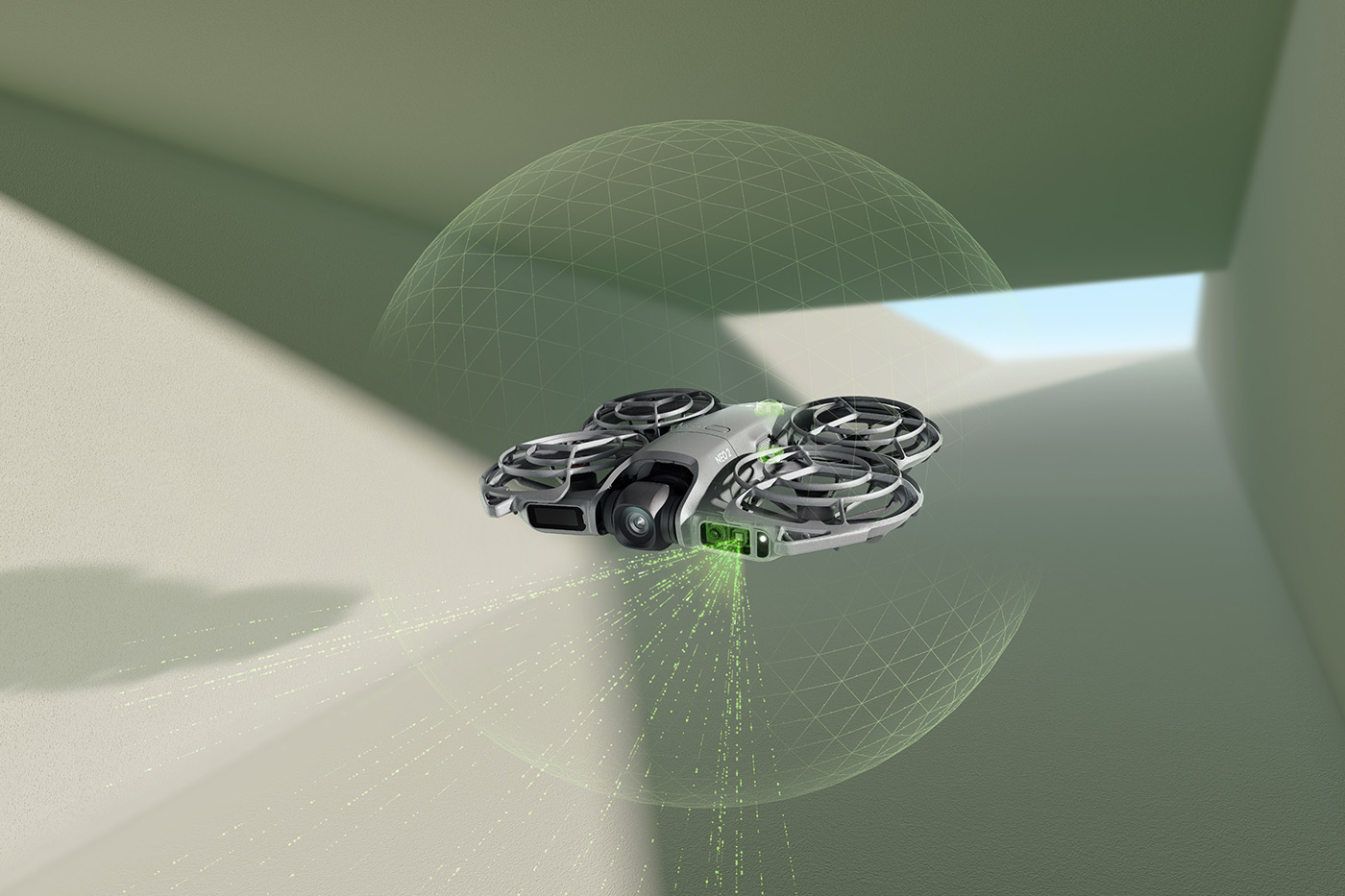
Omnidirectional obstacle sensing detects objects from multiple directions and improves navigation in complex environments [2]. Performance depends on lighting and surface detail, with limitations outlined in the user manual.
Camera and video
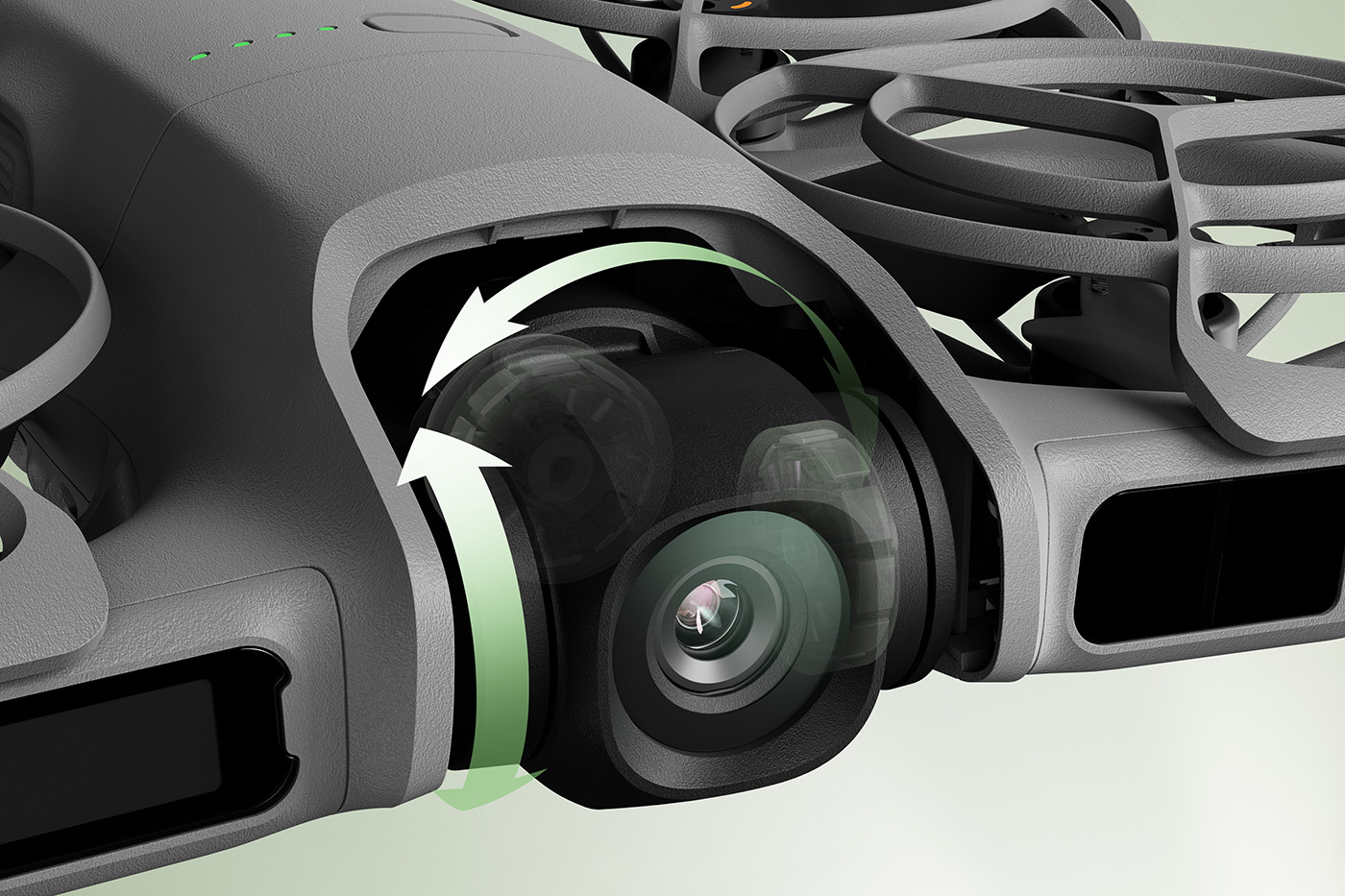
The drone uses a 12MP 1/2-inch CMOS sensor with an f/2.2 aperture. The DJI Neo 2 camera records 4K video at up to 60fps, with 100fps slow-motion available in supported modes [7][15]. A 2-axis gimbal and electronic stabilisation maintain smoother footage during movement [16], and 2.7K vertical video supports mobile-first capture.
Neo 2 memory and internal storage
The Neo 2 memory capacity is 49GB, allowing video recording without a microSD card for shorter sessions. File transfer speeds reach up to 80 MB/s in low-interference environments [18].
Flight time
The DJI Neo 2 flight time reaches up to 19 minutes per battery under measured test conditions [19][20]. This supports multiple short flights, including repeated palm take-offs and landings.
Neo 2 wind resistance
The DJI Neo 2 wind resistance supports stable hovering in wind speeds up to 10.7 m/s, allowing outdoor use in moderate conditions.
Max distance and transmission range
The DJI Neo 2 max distance reaches up to 500m over Wi-Fi in low-interference environments [18]. When used with a compatible controller, transmission can extend up to 10 km under FCC conditions [13].
Size and weight
The DJI Neo 2 weight remains at 151g including the battery, keeping it within the ultra-light category. Its compact size allows it to be carried easily for travel and everyday use.
Safety systems
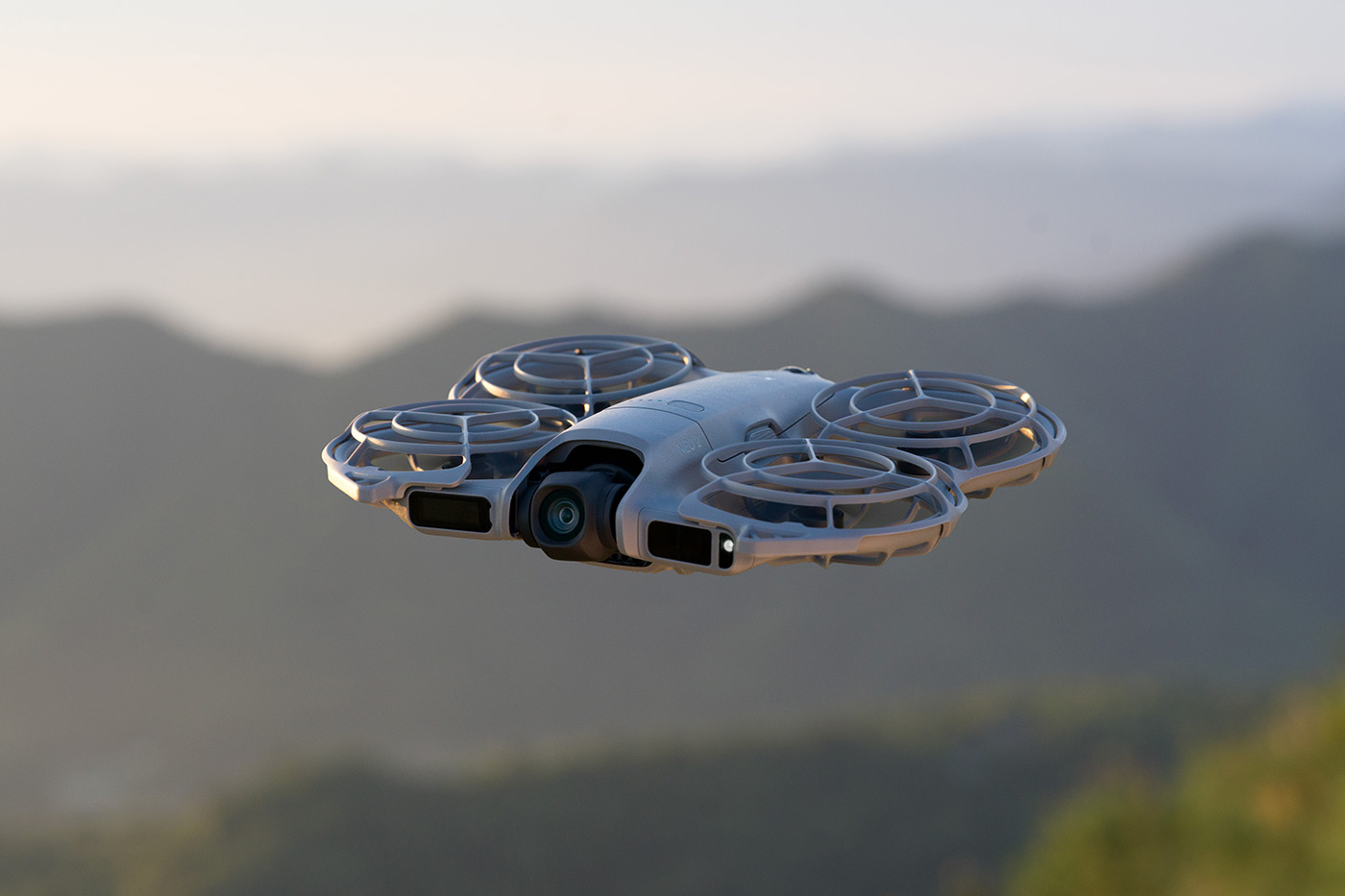
Full-coverage propeller guards provide physical protection during close-range flight. The vision system combines forward sensing, LiDAR and downward infrared detection for improved positioning and obstacle awareness. Stability is maintained across indoor and outdoor environments, including low-texture or reflective surfaces [6].
Battery and charging
The battery charges via USB-C or through an optional two-way charging hub, which supports charging multiple batteries simultaneously [17]. Charging speed depends on the power output of the connected adapter.
Kits and options
The Drone Only includes the aircraft and a single battery. The Fly More Combo adds additional batteries and a charging hub. The Motion Fly More Combo includes goggles and a motion controller for FPV operation.
Browse the options here:
- DJI Neo 2 (Drone Only) includes the drone, one Intelligent Flight Battery and propeller guards.
- DJI Neo 2 Fly More Combo adds two extra batteries, a Neo 2 Two-Way Charging Hub, propeller guards and accessories.
- DJI Neo 2 Motion Fly More Combo includes the RC Motion 3 controller and Goggles N3 for an immersive FPV experience.
Where Neo 2 fits into the range
Neo 2 focuses on hands-free tracking and automated capture rather than manual flying or long-range filming. Compared to DJI Mini drones, it prioritises subject tracking and quick setup, while Avata models offer a more advanced FPV flying experience. It sits as a self-flying camera drone for everyday content rather than a traditional aerial camera.
Your Scenario, Your Choice
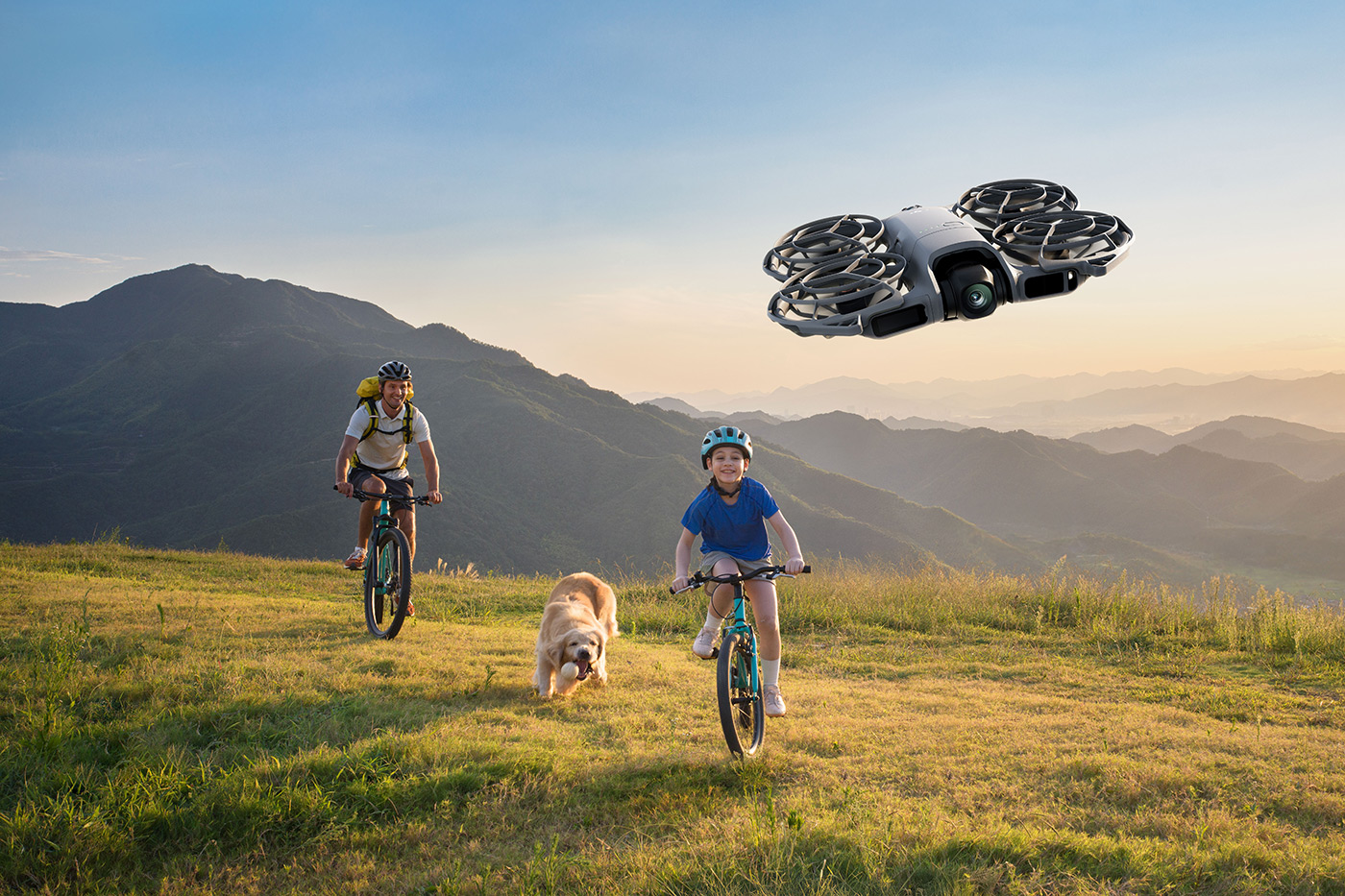
From family outings and sports to travel and indoor FPV flying, DJI Neo 2 adapts to your lifestyle. It’s easy to control, simple to transport and always ready to capture your best moments.
For a closer look at real-world performance, read our DJI Neo 2 review with combo comparisons and more detailed insights.
Frequently Asked Questions
What is included in the Neo 2 Motion Fly More Combo?
It includes the drone, motion controller, DJI Goggles, multiple batteries, a charging hub and essential accessories for FPV and extended use.
How does the drone motion controller work?
The motion controller translates hand movements into flight direction, allowing you to steer the drone intuitively while viewing the live feed through goggles [12].
Do you need goggles to use the Motion Combo?
Goggles are required for FPV flight with the motion controller, but the drone can still be used with app control, gesture input and automated modes [8].
What is the difference between Motion Combo and Fly More Combo?
The Motion Combo adds FPV goggles and a motion controller for immersive flight, while the Fly More Combo focuses on extended flight time with additional batteries and a controller.
What is the Neo 2 max distance with FPV control?
Transmission can reach up to 10 km under FCC conditions with a compatible controller [13], while standard Wi-Fi control supports up to 500m in low-interference environments [18].
What is the Neo 2 flight time with multiple batteries?
Each battery provides up to 19 minutes of flight time under measured conditions [19][20], with the included extras extending total session time across multiple flights.
Does the Neo 2 need a microSD card for recording?
No, it includes 49GB of internal storage, so a microSD card is not required for standard use.
What are the Neo 2 camera specs?
It uses a 12MP 1/2-inch CMOS sensor with an f/2.2 aperture and records up to 4K/60fps, with 100fps slow motion available in supported modes [7][15].
Is the Motion Combo suitable for beginners?
It can be used by beginners, but FPV control introduces a different flying experience. Automated modes and app control remain available for simpler operation.
Lifestyle images
Notes
[1] As of November 2025, DJI Neo 2 is the most compact drone in DJI’s lineup to feature omnidirectional obstacle sensing.
[2] The vision system supports obstacle detection under specific lighting and surface conditions; see the user manual for limitations.
[3] Gesture control and Return to Palm should be used in open, well-lit environments. Keep 2–5 m distance and avoid reflective or moving surfaces.
[4] Use ActiveTrack in open spaces and refer to the manual for unsupported conditions.
[5] Use palm take-off and landing in calm wind and keep your hand flat and steady.
[6] Versatile flight covers improved indoor and outdoor stability, especially over reflective or low-texture surfaces.
[7] 4K/100fps recording is supported only with the remote or motion controller.
[8] Requires DJI Goggles N3 or DJI Goggles 3 and compatible motion controller.
[9] Voice control currently supports English and Mandarin.
[10] Requires connection to a mobile device via Wi-Fi.
[11] Check the Bluetooth Device Compatibility List for supported earphones.
[12] Requires DJI Neo 2 Digital Transceiver for RC and motion control functions.
[13] The 10 km transmission range is based on FCC compliance in ideal outdoor conditions.
[14] Measured in open, windless environments; actual performance may vary.
[15] 4K/100fps recording available only in supported modes.
[16] Stabilisation can be toggled in goggles; Gyroflow supports offline stabilisation.
[17] Charging speed depends on charger power output.
[18] Transfer speed measured in low-interference lab conditions.
[19] Tested in windless conditions at sea level; results may differ in real-world use.
[20] Flight time measured during continuous short flights using standard modes.
DJI Neo 2 Specifications
|
Take-off weight |
151 g (without Digital Transceiver); 160 g (with Digital Transceiver) |
|
Dimensions |
147 x 171 x 41 mm (with propeller guards, no Transceiver) / 167 x 171 x 54 mm (with propeller guards and Transceiver) |
|
Maximum ascent speed |
0.5 m/s (Cine), 3 m/s (Normal), 5 m/s (Sport) |
|
Maximum descent speed |
0.5 m/s (Cine), 3 m/s (Normal), 3 m/s (Sport) |
|
Maximum horizontal speed |
8 m/s (Normal), 12 m/s (Sport or Tracking) |
|
Maximum take-off altitude |
2000 m |
|
Maximum flight time |
Approx. 19 minutes (17 minutes with propeller guards) |
|
Maximum hovering time |
Approx. 18 minutes (16.5 minutes with propeller guards) |
|
Maximum flight distance |
7 km |
|
Maximum wind-speed resistance |
10.7 m/s (Level 5) |
|
Operating temperature |
−10 °C to 40 °C (14 °F to 104 °F) |
|
GNSS positioning systems |
GPS, Galileo and BeiDou |
|
Hovering accuracy (vertical / horizontal) |
±0.1 m / ±0.3 m (vision positioning); ±0.5 m / ±1.5 m (satellite positioning) |
|
Internal storage |
49 GB |
|
Class (EU) |
C0 |
|
Image sensor |
1/2-inch CMOS, 12 MP |
|
Lens |
FOV 119.8° / 16.5 mm equivalent / f 2.2 / focus 0.7 m to ∞ |
|
ISO range |
Photo 100 – 12 800 / Video 100 – 12 800 |
|
Shutter speed |
Video 1/8000 – 1/30 s / Photo 1/8000 – 1/10 s |
|
Maximum image size |
4000 x 3000 (4:3) / 4000 x 2250 (16:9) |
|
Still photo modes |
Single or Timed Shot (2 – 60 s intervals) |
|
Photo format |
JPEG |
|
Video resolution |
4K (4:3) 3840 x 2880 @ 60 / 50 / 30 fps; 4K (16:9) 3840 x 2160 @ 100 / 60 / 50 / 30 fps; 2.7K (9:16) 1512 x 2688 @ 60 / 50 / 30 fps |
|
Video format |
MP4 (H.264 / H.265) |
|
Maximum video bitrate |
80 Mbps |
|
Colour mode |
Normal |
|
Stabilisation |
2-axis mechanical gimbal (tilt and roll) with EIS support |
|
Gimbal tilt range |
−90° to 70° |
|
Sensing system |
Omnidirectional monocular vision with forward LiDAR and downward infrared sensors |
|
Video transmission system |
Wi-Fi standard / O4 Digital Transceiver optional |
|
Live view quality |
Up to 1080p @ 60 fps (with RC controllers or Goggles N3) |
|
Operating frequency bands |
2.4 GHz and 5.8 GHz |
|
Maximum transmission distance |
Up to 10 km (FCC) / 6 km (CE) |
|
Download speed (QuickTransfer) |
Up to 80 MB/s |
|
Maximum video transmission bitrate |
60 Mbps |
|
Battery capacity |
1606 mAh |
|
Charging time |
Approx. 68 minutes (using Two-Way Charging Hub) |
|
Recommended charger |
DJI 65 W Portable Charger or USB-PD charger |
What's in the Box
- DJI Neo 2 Aircraft x1
- DJI RC Motion 3 x1
- DJI Goggles N3 x1
- DJI Neo 2 Intelligent Flight Battery x3
- DJI Neo 2 Two-Way Charging Hub x1
- DJI Neo 2 Spare Propellers (Pair) x1
- DJI Neo 2 Spare Propeller Screw x4
- Screwdriver x1
- DJI Neo 2 Propeller Guard (Pair) x1
- DJI Neo 2 Gimbal Protector x1
- USB-C to USB-C Data Cable x1
- Documents (Quick Start Guide, Safety Guidelines, and DJI Logo Stickers) x1
Specifications
|
Take-off weight |
151 g (without Digital Transceiver); 160 g (with Digital Transceiver) |
|
Dimensions |
147 x 171 x 41 mm (with propeller guards, no Transceiver) / 167 x 171 x 54 mm (with propeller guards and Transceiver) |
|
Maximum ascent speed |
0.5 m/s (Cine), 3 m/s (Normal), 5 m/s (Sport) |
|
Maximum descent speed |
0.5 m/s (Cine), 3 m/s (Normal), 3 m/s (Sport) |
|
Maximum horizontal speed |
8 m/s (Normal), 12 m/s (Sport or Tracking) |
|
Maximum take-off altitude |
2000 m |
|
Maximum flight time |
Approx. 19 minutes (17 minutes with propeller guards) |
|
Maximum hovering time |
Approx. 18 minutes (16.5 minutes with propeller guards) |
|
Maximum flight distance |
7 km |
|
Maximum wind-speed resistance |
10.7 m/s (Level 5) |
|
Operating temperature |
−10 °C to 40 °C (14 °F to 104 °F) |
|
GNSS positioning systems |
GPS, Galileo and BeiDou |
|
Hovering accuracy (vertical / horizontal) |
±0.1 m / ±0.3 m (vision positioning); ±0.5 m / ±1.5 m (satellite positioning) |
|
Internal storage |
49 GB |
|
Class (EU) |
C0 |
|
Image sensor |
1/2-inch CMOS, 12 MP |
|
Lens |
FOV 119.8° / 16.5 mm equivalent / f 2.2 / focus 0.7 m to ∞ |
|
ISO range |
Photo 100 – 12 800 / Video 100 – 12 800 |
|
Shutter speed |
Video 1/8000 – 1/30 s / Photo 1/8000 – 1/10 s |
|
Maximum image size |
4000 x 3000 (4:3) / 4000 x 2250 (16:9) |
|
Still photo modes |
Single or Timed Shot (2 – 60 s intervals) |
|
Photo format |
JPEG |
|
Video resolution |
4K (4:3) 3840 x 2880 @ 60 / 50 / 30 fps; 4K (16:9) 3840 x 2160 @ 100 / 60 / 50 / 30 fps; 2.7K (9:16) 1512 x 2688 @ 60 / 50 / 30 fps |
|
Video format |
MP4 (H.264 / H.265) |
|
Maximum video bitrate |
80 Mbps |
|
Colour mode |
Normal |
|
Stabilisation |
2-axis mechanical gimbal (tilt and roll) with EIS support |
|
Gimbal tilt range |
−90° to 70° |
|
Sensing system |
Omnidirectional monocular vision with forward LiDAR and downward infrared sensors |
|
Video transmission system |
Wi-Fi standard / O4 Digital Transceiver optional |
|
Live view quality |
Up to 1080p @ 60 fps (with RC controllers or Goggles N3) |
|
Operating frequency bands |
2.4 GHz and 5.8 GHz |
|
Maximum transmission distance |
Up to 10 km (FCC) / 6 km (CE) |
|
Download speed (QuickTransfer) |
Up to 80 MB/s |
|
Maximum video transmission bitrate |
60 Mbps |
|
Battery capacity |
1606 mAh |
|
Charging time |
Approx. 68 minutes (using Two-Way Charging Hub) |
|
Recommended charger |
DJI 65 W Portable Charger or USB-PD charger |